
Who We Are

The Colorado Monitoring Framework (CMF) is a nonprofit organization that fosters collaboration among water quality stakeholders to support compliance with nutrient regulations and improve water quality throughout Colorado. CMF was formed in response to nutrient water quality regulations adopted by the Colorado Water Quality Control Commission in 2012, particularly in priority basins such as the South Platte and Arkansas River watersheds.

Regulation 85, the Nutrient Management Control Regulation, requires point source dischargers to collect and report effluent and in-stream nutrient data to the Water Quality Control Division. CMF recognizes that regulatory monitoring data, coupled with relevant and additional information collected in a collaborative manner, is critical to developing site-specific nutrient standards and tracking water quality improvements over time. As such, cooperative water quality data management and analysis activities are central to CMF’s mission.

Collaborative Approach

CMF brings together municipalities, industries, agricultural interests, and regulators to address shared water quality challenges through coordination and partnership.

Science-Based Decision Making

Our work is grounded in monitoring data, scientific analysis, and technical expertise to support informed water quality management.

Statewide Impact

By sharing data and best practices across watersheds, CMF helps improve water quality outcomes and advance effective nutrient management throughout Colorado.

Role of CMF in Colorado’s Water Quality Community

The CMF was developed to support municipal, industrial, and agricultural interests and address increasingly complex regulations and compliance requirements.

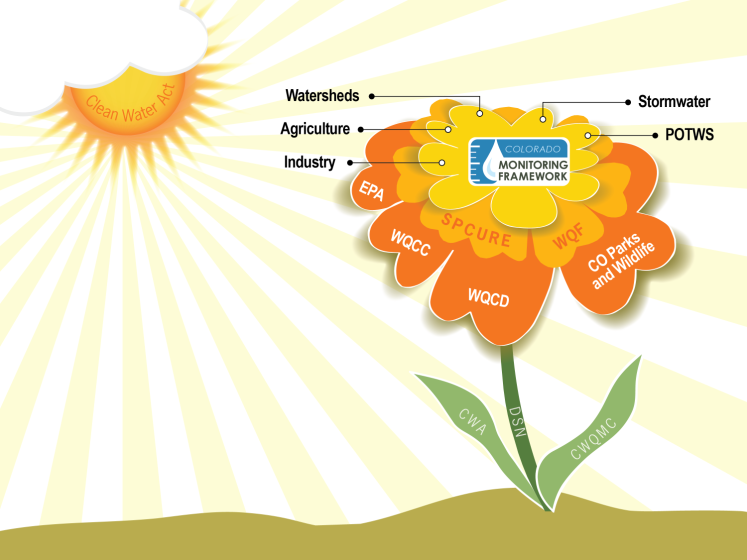
The flower graphic illustrates the function of the CMF within Colorado’s broader water quality framework and the many layers of Clean Water Act implementation. Closest to the heart of the flower are the supporting entities that contribute through dues and direct participation. The next layer lists organizations with which CMF interacts and communicates. Lastly, strong support comes from the base in foundational science that is used for sound decision making. More information about the CMF can be found here: CMF Brochure

Board of Directors

The Board of Directors provides leadership and oversight for CMF by guiding organizational activities, establishing budgets, approving work products, forming ad hoc committees, setting membership dues, and authorizing contracts. The Board’s Co-Chairs are responsible for conducting the day-to-day business of the organization.

The Board consists of up to seven members elected annually by the CMF membership. Board members are selected from volunteers within the membership and are encouraged to reflect diverse geographic regions, organization sizes, and stakeholder interests. Co-Chairs are elected by and from among the Board members. Only CMF members are eligible to serve on the Board, and there are no term limits for Board service.

Board actions are approved by a majority vote of the total Board membership. Approval does not require participation from every Board member, only that a majority vote in favor of the action. Voting may occur during meetings or through other approved methods of communication, including email, text message, or other electronic means.

Members and Partners